Table of Contents
1. Introduction
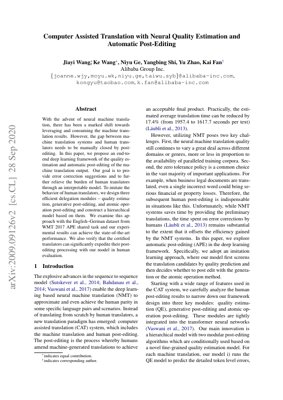
The advent of Neural Machine Translation (NMT) has shifted the paradigm towards leveraging machine-generated translations. However, the quality gap between NMT output and human standards necessitates manual post-editing, a time-consuming process. This paper proposes an end-to-end deep learning framework that integrates Quality Estimation (QE) and Automatic Post-Editing (APE). The goal is to provide error correction suggestions and reduce the burden on human translators through an interpretable, hierarchical model that imitates human post-editing behavior.
2. Related Work
This work builds upon several intertwined research threads: Neural Machine Translation (NMT), Quality Estimation (predicting translation quality without references), and Automatic Post-Editing (automatically correcting MT output). It positions itself within the Computer-Assisted Translation (CAT) ecosystem, aiming to move beyond standalone MT or QE systems towards an integrated, decision-driven pipeline.
3. Methodology
The core innovation is a hierarchical model with three delegation modules, tightly integrated into Transformer neural networks.
3.1 Hierarchical Model Architecture
The model first screens MT candidates via a fine-grained QE module. Based on the predicted overall quality score, it conditionally routes the sentence to one of two post-editing paths.
3.2 Quality Estimation Module
This module predicts detailed token-level errors (e.g., mistranslation, omission) which are aggregated into an overall sentence-level quality score. It uses a Transformer-based encoder to analyze the source sentence and the MT output.
3.3 Generative Post-Editing
For sentences deemed low quality by the QE module, a sequence-to-sequence generative model (based on Transformer) is employed to rephrase and rewrite the translation entirely. This is akin to a full re-translation focused on the problematic segment.
3.4 Atomic Operation Post-Editing
For high quality sentences with minor errors, a more efficient module is used. It predicts a sequence of atomic edit operations (e.g., KEEP, DELETE, REPLACE_WITH_X) at the token level, minimizing changes to the original MT output. The probability of an operation $o_t$ at position $t$ can be modeled as: $P(o_t | \mathbf{s}, \mathbf{mt}_{1:t}) = \text{Softmax}(\mathbf{W} \cdot \mathbf{h}_t + \mathbf{b})$ where $\mathbf{h}_t$ is the hidden state from the model, $\mathbf{s}$ is the source, and $\mathbf{mt}$ is the machine translation.
4. Experiments & Results
4.1 Dataset & Setup
Evaluation was conducted on the English–German dataset from the WMT 2017 APE shared task. Standard metrics BLEU (higher is better) and TER (Translation Edit Rate, lower is better) were used.
4.2 Quantitative Results (BLEU/TER)
The proposed hierarchical model achieved state-of-the-art performance on the WMT 2017 APE task, outperforming top-ranked methods in both BLEU and TER scores. This demonstrates the effectiveness of the conditional routing strategy and the dual post-editing approach.
Key Performance Metrics
BLEU Score: Achieved superior results compared to previous SOTA.
TER Score: Significantly reduced edit distance, indicating higher fidelity post-edits.
4.3 Human Evaluation
In a controlled human evaluation, certified translators were asked to post-edit MT outputs with and without the assistance of the proposed APE system. The results showed a significant reduction in post-editing time when using the APE suggestions, confirming the practical utility of the system in a real-world CAT workflow.
5. Technical Analysis & Framework
5.1 Core Insight & Logical Flow
Core Insight: The paper's fundamental breakthrough isn't just another APE model; it's the strategic decomposition of the human post-editor's cognitive process into a decision tree executable by neural networks. Instead of a monolithic "fix-it" model, they emulate the expert translator's first step: assess, then act appropriately. This mirrors the "estimation then action" pipeline seen in advanced robotics and reinforcement learning, applying it to linguistic correction. The choice between generative and atomic editing is a direct analog to a human deciding between rewriting a clumsy paragraph or simply correcting a typo.
Logical Flow: The pipeline is elegantly sequential but conditional. 1) Diagnosis (QE): A fine-grained, token-level error detection system acts as the diagnostic tool. This is more advanced than sentence-level scoring, providing a "heatmap" of issues. 2) Triage: The diagnosis aggregates into a binary decision: is this a "sick" sentence (low quality) or a "healthy" one with minor ailments (high quality)? 3) Treatment: Critical cases (low quality) get the intensive care of a full generative model—a complete re-translation of the problematic span. Stable cases (high quality) get minimally invasive surgery via atomic operations. This flow ensures computational resources are allocated efficiently, a principle borrowed from system optimization theory.
5.2 Strengths & Flaws
Strengths:
- Human-Centric Design: The three-module structure is its greatest strength. It doesn't treat APE as a black-box text-to-text problem but breaks it down into interpretable sub-tasks (QE, major rewrite, minor edit), making system outputs more trustworthy and debuggable for professional translators. This aligns with the push for explainable AI in critical applications.
- Resource Efficiency: The conditional execution is smart. Why run a computationally heavy generative model on a sentence that only needs a word swapped? This dynamic routing, reminiscent of mixture-of-experts models or Google's Switch Transformer, offers a scalable path for deployment.
- Empirical Validation: Solid results on WMT benchmarks coupled with real human evaluation showing time savings is the gold standard. Too many papers stop at BLEU scores; proving efficacy in a user study is convincing evidence of practical value.
Flaws & Limitations:
- Binary Triage Oversimplification: The high/low quality dichotomy is a critical bottleneck. Human post-editing exists on a spectrum. A sentence could be 80% correct but have one critical, context-breaking error (a "high" score with a fatal flaw). The binary gate might misroute it to atomic edits, missing the need for a local but deep regeneration. The QE module needs confidence scores or multi-class error severity labels.
- Training Complexity & Pipeline Fragility: This is a multi-stage pipeline (QE model -> router -> one of two PE models). Errors compound. If the QE model is miscalibrated, the entire system's performance degrades. Training such a system end-to-end is notoriously difficult, often requiring sophisticated techniques like Gumbel-Softmax for routing differentiation or reinforcement learning, which the paper may not fully address.
- Domain & Language Pair Lock-in: Like most deep learning MT/APE systems, its performance is heavily dependent on the quality and quantity of parallel data for the specific language pair and domain (e.g., WMT En-De). The paper does not explore low-resource language pairs or rapid adaptation to new domains (e.g., legal to medical), which is a major hurdle for enterprise CAT tools. Techniques like meta-learning or adapter modules, as explored in recent NLP research, could be necessary next steps.
5.3 Actionable Insights
For Researchers:
- Explore Soft Routing: Ditch the hard binary decision. Investigate a soft, weighted combination of the generative and atomic editors, where the QE module's output weights the contribution of each. This could be more robust to QE errors.
- Integrate External Knowledge: The current model relies purely on the source and MT sentence. Incorporate features from translation memory (TM) databases or terminology bases—standard tools in professional CAT suites—as additional context. This bridges the gap between pure neural approaches and traditional localization engineering.
- Benchmark on Real-World CAT Logs: Move beyond WMT shared tasks. Partner with a translation agency to test on real, messy, multi-domain translation projects with translator interaction logs. This will reveal true failure modes.
For Product Developers (CAT Tool Vendors):
- Implement as a Quality Gate: Use the QE module as a pre-filter in translation management systems. Automatically flag low-confidence segments for senior reviewer attention or pre-populate them with generative APE suggestions, streamlining the review workflow.
- Focus on the Atomic Editor for UI Integration: The atomic operation output (KEEP/DELETE/REPLACE) is perfect for interactive interfaces. It can power smart, predictive text editing where the translator uses keyboard shortcuts to accept/reject/edit atomic suggestions, drastically reducing keystrokes.
- Prioritize Model Adaptability: Invest in developing efficient fine-tuning or domain adaptation pipelines for the APE system. Enterprise clients need models tailored to their specific jargon and style guides within days, not months.
Analysis Framework Example Case
Scenario: A legal document translation from English to German.
Source: "The party shall indemnify the other party for all losses."
Baseline MT Output: "Die Partei wird die andere Partei für alle Verluste entschädigen." (Correct, but uses "Partei" which might be too informal/ambiguous in a strict contract context. A better term might be "Vertragspartei").
Proposed Model Workflow:
- QE Module: Analyzes the segment. Most tokens are correct, but flags "Partei" as a potential terminology mismatch (not necessarily an error, but a sub-optimal term choice). The sentence receives a "high quality" score.
- Routing: Sent to the Atomic Operation Post-Editing module.
- Atomic Editor: Given the source and context, it might propose the operation sequence:
[KEEP, KEEP, REPLACE_WITH_'Vertragspartei', KEEP, KEEP, KEEP, KEEP]. - Output: "Die Vertragspartei wird die andere Vertragspartei für alle Verluste entschädigen." This is a precise, minimal edit that aligns with legal terminology standards.
6. Future Applications & Directions
The implications of this integrated QE-APE framework extend beyond traditional translation:
- Adaptive MT Systems: The QE signal can be fed back in real-time to an NMT system for online adaptation or reinforcement learning, creating a self-improving translation loop.
- Content Moderation & Localization: The atomic operation module could be adapted to automatically localize or moderate user-generated content by applying culturally appropriate replacements or redactions based on policy rules.
- Education and Training: The system can serve as an intelligent tutor for translation students, providing detailed error analysis (from the QE module) and suggested corrections.
- Multimodal Translation: Integrating similar quality estimation and post-editing principles for image-based (OCR translation) or speech-to-speech translation systems, where errors have different modalities.
- Low-Resource & Unsupervised Settings: Future work must tackle applying these principles where large parallel corpora are unavailable, potentially using unsupervised or semi-supervised techniques inspired by works like CycleGAN for unpaired image translation, but applied to text.
7. References
- Wang, J., Wang, K., Ge, N., Shi, Y., Zhao, Y., & Fan, K. (2020). Computer Assisted Translation with Neural Quality Estimation and Automatic Post-Editing. arXiv preprint arXiv:2009.09126.
- Vaswani, A., Shazeer, N., Parmar, N., Uszkoreit, J., Jones, L., Gomez, A. N., ... & Polosukhin, I. (2017). Attention is all you need. Advances in neural information processing systems, 30.
- Specia, L., Shah, K., de Souza, J. G., & Cohn, T. (2013). QuEst - A translation quality estimation framework. In Proceedings of the 51st Annual Meeting of the Association for Computational Linguistics: System Demonstrations.
- Junczys-Dowmunt, M., & Grundkiewicz, R. (2016). Log-linear combinations of monolingual and bilingual neural machine translation models for automatic post-editing. In Proceedings of the First Conference on Machine Translation.
- Isola, P., Zhu, J. Y., Zhou, T., & Efros, A. A. (2017). Image-to-image translation with conditional adversarial networks. In Proceedings of the IEEE conference on computer vision and pattern recognition (pp. 1125-1134). (Cited for conceptual analogy to conditional, task-specific transformation).
- Läubli, S., Fishel, M., Massey, G., Ehrensberger-Dow, M., & Volk, M. (2013). Assessing post-editing efficiency in a realistic translation environment. Proceedings of MT Summit XIV.