1. Introduction
Retrieval-augmented Neural Machine Translation (NMT) enhances standard NMT models by incorporating similar translation examples (Translation Memories, TMs) from a database during the translation process. While effective, traditional methods often retrieve redundant and mutually similar TMs, limiting the information gain. This paper introduces a novel framework, the Contrastive Memory Model, which addresses this limitation by focusing on retrieving and utilizing contrastive TMs—those that are holistically similar to the source sentence but individually diverse and non-redundant.
The core hypothesis is that a diverse set of TMs provides maximal coverage and useful cues from different aspects of the source sentence, leading to better translation quality. The proposed model operates in three key phases: (1) a contrastive retrieval algorithm, (2) a hierarchical memory encoding module, and (3) a multi-TM contrastive learning objective.
2. Methodology
The proposed framework systematically integrates contrastive principles into the retrieval-augmented NMT pipeline.
2.1 Contrastive Retrieval Algorithm
Instead of greedy retrieval based solely on source similarity, the authors propose a method inspired by Maximal Marginal Relevance (MMR). Given a source sentence $s$, the goal is to retrieve a set of $K$ TMs $\mathcal{M} = \{m_1, m_2, ..., m_K\}$ that maximizes both relevance to $s$ and diversity within the set. The retrieval score for a candidate TM $m_i$ given the already selected set $S$ is defined as:
$\text{Score}(m_i) = \lambda \cdot \text{Sim}(s, m_i) - (1-\lambda) \cdot \max_{m_j \in S} \text{Sim}(m_i, m_j)$
where $\text{Sim}(\cdot)$ is a similarity function (e.g., edit distance or semantic similarity), and $\lambda$ balances relevance and diversity. This ensures the selected TMs are informative and non-redundant.
2.2 Hierarchical Group Attention
To effectively encode the retrieved set of TMs, a novel Hierarchical Group Attention (HGA) module is introduced. It operates at two levels:
- Local Attention: Encodes the contextual information within each individual TM.
- Global Attention: Aggregates information across all TMs in the set to capture the collective, global context.
This dual-level encoding allows the model to leverage both fine-grained details from specific TMs and the overarching thematic or structural patterns from the entire TM set.
2.3 Multi-TM Contrastive Learning
During training, a Multi-TM Contrastive Learning objective is employed. It encourages the model to distinguish the most salient features of each TM with respect to the target translation. The loss function pulls the representation of the ground-truth target closer to the aggregated representation of the relevant TMs while pushing it away from irrelevant or less informative TMs, enhancing the model's ability to select and combine useful information.
3. Experimental Results
3.1 Datasets & Baselines
Experiments were conducted on standard benchmark datasets for NMT, including WMT14 English-German and English-French. Strong baselines were compared, including standard Transformer-based NMT and state-of-the-art retrieval-augmented models like the one proposed by Gu et al. (2018).
3.2 Main Results & Analysis
The proposed Contrastive Memory Model achieved consistent improvements over all baselines in terms of BLEU scores. For instance, on WMT14 En-De, it outperformed the strong retrieval-augmented baseline by +1.2 BLEU points. The results validate the hypothesis that diverse, contrastive TMs are more beneficial than redundant ones.
Key Performance Improvement
+1.2 BLEU over SOTA retrieval-augmented baseline on WMT14 En-De.
3.3 Ablation Studies
Ablation studies confirmed the contribution of each component:
- Removing the contrastive retrieval (using greedy retrieval) led to a significant drop in performance.
- Replacing Hierarchical Group Attention with a simple concatenation or averaging of TM embeddings also degraded results.
- The multi-TM contrastive loss was crucial for learning effective TM representations.
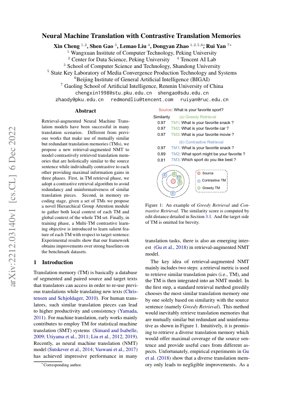
Figure 1 in the PDF visually demonstrates the difference between Greedy Retrieval and Contrastive Retrieval, showing how the latter selects TMs with varying semantic focuses (e.g., "snack", "car", "movie" vs. "sport") rather than near-identical ones.
4. Analysis & Discussion
Industry Analyst Perspective: A Four-Step Deconstruction
4.1 Core Insight
The paper's fundamental breakthrough isn't just another attention variant; it's a strategic shift from data quantity to data quality in retrieval-augmented models. For years, the field operated under an implicit assumption: more similar examples are better. This work convincingly argues that's wrong. Redundancy is the enemy of information gain. By borrowing the principle of contrastive learning—successful in domains like self-supervised vision (e.g., SimCLR, Chen et al.)—and applying it to retrieval, they reframe the TM selection problem from a simple similarity search to a portfolio optimization problem for linguistic features. This is a far more sophisticated and promising direction.
4.2 Logical Flow
The argument is elegantly constructed. First, they identify the critical flaw in prior art (redundant retrieval) with a clear visual example (Figure 1). Second, they propose a three-pronged solution that attacks the problem holistically: (1) Source (Contrastive Retrieval for better inputs), (2) Model (HGA for better processing), and (3) Objective (Contrastive Loss for better learning). This isn't a one-trick pony; it's a full-stack redesign of the retrieval-augmented pipeline. The logic is compelling because each component addresses a specific weakness created by introducing diversity, preventing the model from being overwhelmed by disparate information.
4.3 Strengths & Flaws
Strengths:
- Conceptual Elegance: The application of MMR and contrastive learning is intuitive and well-motivated.
- Empirical Rigor: Solid gains on standard benchmarks with thorough ablation studies that isolate each component's contribution.
- Generalizable Framework: The principles (diversity-seeking retrieval, hierarchical encoding of sets) could extend beyond NMT to other retrieval-augmented tasks like dialogue or code generation.
- Computational Overhead: The contrastive retrieval step and HGA module add complexity. The paper is light on latency and throughput analysis compared to simpler baselines—a critical metric for real-world deployment.
- TM Database Quality Dependence: The method's efficacy is inherently tied to the diversity present in the TM database. In niche domains with inherently homogeneous data, gains may be marginal.
- Hyperparameter Sensitivity: The $\lambda$ parameter in the retrieval score balances relevance and diversity. The paper doesn't deeply explore the sensitivity of results to this key choice, which could be a tuning headache in practice.
4.4 Actionable Insights
For practitioners and researchers:
- Immediately Audit Your Retrieval: If you're using retrieval-augmentation, implement a simple diversity check on your top-k results. Redundancy is likely costing you performance.
- Prioritize Data Curation: This research underscores that model performance starts with data quality. Investing in curating diverse, high-quality translation memory databases may yield higher ROI than chasing marginal architectural improvements on static data.
- Explore Cross-Domain Applications: The core idea is not NMT-specific. Teams working on retrieval-augmented chatbots, semantic search, or even few-shot learning should experiment with injecting similar contrastive retrieval and set-encoding mechanisms.
- Pressure-Test Efficiency: Before adoption, rigorously benchmark the inference speed and memory footprint against the performance gain. The trade-off must be justified for production systems.
5. Technical Details
The core technical innovation lies in the Hierarchical Group Attention (HGA). Formally, let $H = \{h_1, h_2, ..., h_K\}$ be the set of encoded representations for $K$ TMs. The local context $c_i^{local}$ for the $i$-th TM is obtained via self-attention over $h_i$. The global context $c^{global}$ is computed by attending to all TM representations: $c^{global} = \sum_{j=1}^{K} \alpha_j h_j$, where $\alpha_j$ is an attention weight derived from a query (e.g., the source sentence encoding). The final representation for the TM set is a gated combination: $c^{final} = \gamma \cdot c^{global} + (1-\gamma) \cdot \text{MeanPool}(\{c_i^{local}\})$, where $\gamma$ is a learned gate.
The Multi-TM Contrastive Loss can be formulated as an InfoNCE-style loss: $\mathcal{L}_{cont} = -\log \frac{\exp(sim(q, k^+)/\tau)}{\sum_{i=1}^{N} \exp(sim(q, k_i)/\tau)}$, where $q$ is the target representation, $k^+$ is the aggregated positive TM representation, and $\{k_i\}$ include negative samples (other TM sets or irrelevant targets).
6. Case Study & Framework
Analysis Framework Example: Consider a company building a technical documentation translator. Their TM database contains many similar sentences about "clicking the button." A greedy retrieval system would fetch multiple near-identical examples. Applying the contrastive retrieval framework, the system would be guided to also retrieve examples about "pressing the key," "selecting the menu item," or "tapping the icon"—diverse phrasings for similar actions. The HGA module would then learn that while the local context of each phrase differs, their global context relates to "user interface interaction." This enriched, multi-perspective input enables the model to generate a more natural and varied translation (e.g., avoiding repetitive use of "click") compared to a model trained on redundant data. This framework moves translation memory from a simple copy-paste tool to a creative paraphrasing assistant.
7. Future Applications & Directions
The principles established here have broad implications:
- Low-Resource & Domain Adaptation: Contrastive retrieval can be pivotal for finding the most informative and diverse few-shot examples for adapting a general NMT model to a specialized domain (e.g., legal, medical).
- Interactive Translation Systems: The model could proactively suggest a set of contrastive translation options to human translators, enhancing their productivity and consistency.
- Multimodal Translation: The concept could extend to retrieving not just text, but diverse, complementary modalities (e.g., an image, a related audio description) to aid in translating ambiguous source sentences.
- Dynamic TM Databases: Future work could focus on TM databases that evolve, where the contrastive retrieval algorithm also informs which new translations should be added to maximize future diversity and utility.
- Integration with Large Language Models (LLMs): This framework offers a structured, efficient way to provide in-context examples to LLMs for translation, potentially reducing hallucination and improving controllability compared to naive prompting.
8. References
- Cheng, X., Gao, S., Liu, L., Zhao, D., & Yan, R. (2022). Neural Machine Translation with Contrastive Translation Memories. arXiv preprint arXiv:2212.03140.
- Gu, J., Wang, Y., Cho, K., & Li, V. O. (2018). Search engine guided neural machine translation. Proceedings of the AAAI Conference on Artificial Intelligence.
- Vaswani, A., Shazeer, N., Parmar, N., Uszkoreit, J., Jones, L., Gomez, A. N., ... & Polosukhin, I. (2017). Attention is all you need. Advances in neural information processing systems.
- Carbonell, J., & Goldstein, J. (1998). The use of MMR, diversity-based reranking for reordering documents and producing summaries. Proceedings of the 21st annual international ACM SIGIR conference on Research and development in information retrieval.
- Chen, T., Kornblith, S., Norouzi, M., & Hinton, G. (2020). A simple framework for contrastive learning of visual representations. International conference on machine learning.
- Khandelwal, U., Levy, O., Jurafsky, D., Zettlemoyer, L., & Lewis, M. (2020). Generalization through memorization: Nearest neighbor language models. arXiv preprint arXiv:1911.00172.